


Today we explore the role of scheduling, visual timetables, and the integration of inquiry-based learning into your daily classroom routine.
The Power of Visual Timetables
Visual timetables are a game-changer in early childhood. Children thrive on routines and predictability, creating a sense of safety that enhances their ability to learn. Utilising picture schedules with colourful images or icons guides children through the day, easing transitions and reducing anxiety. Displaying the visual timetable during morning circle time establishes expectations, and as trust grows, students can take on the responsibility of displaying daily activities as part of the morning ritual. Ready-made visual timetables can be downloaded from websites like Twinkl or Teach Starter, but of course you can also create your own. Visual timetables are especially beneficial for neurodiverse children, offering a personalised roadmap tailored to their unique needs.
Non-Negotiable Teaching: Anchors of Stability
Early childhood environments come with essential activities:
- story time,
- outdoor play (gross motor, socialisation and problem solving)
- snack time,
- oral language development in the form of show and tell and circle discussions,
- fine motor activities
- arts and crafts
- imaginative play
These non-negotiables, serve as anchors, providing stability and familiarity for the children. Identifying these core elements is crucial, as they form the foundation around which the daily schedule is built.
English is a daily non-negotiable. From Pre Primary/Foundation ( or if you’re in America, Kindergarten) you will focus on phonics and building phonological awareness ( the sounds you hear in words). Phonics should be taught daily, systematically and explicitly. You will need to find or use a program that delivers phonological awareness on a daily basis. This shouldn’t take more than 10 minutes during your morning circle time.
Actually, phonological awareness begins way before PP, when children can be made aware of the sounds in words through nursery rhymes and rhyming picture books. You can download a list of my favourite rhyming picture books for children here and read more in this blog post.
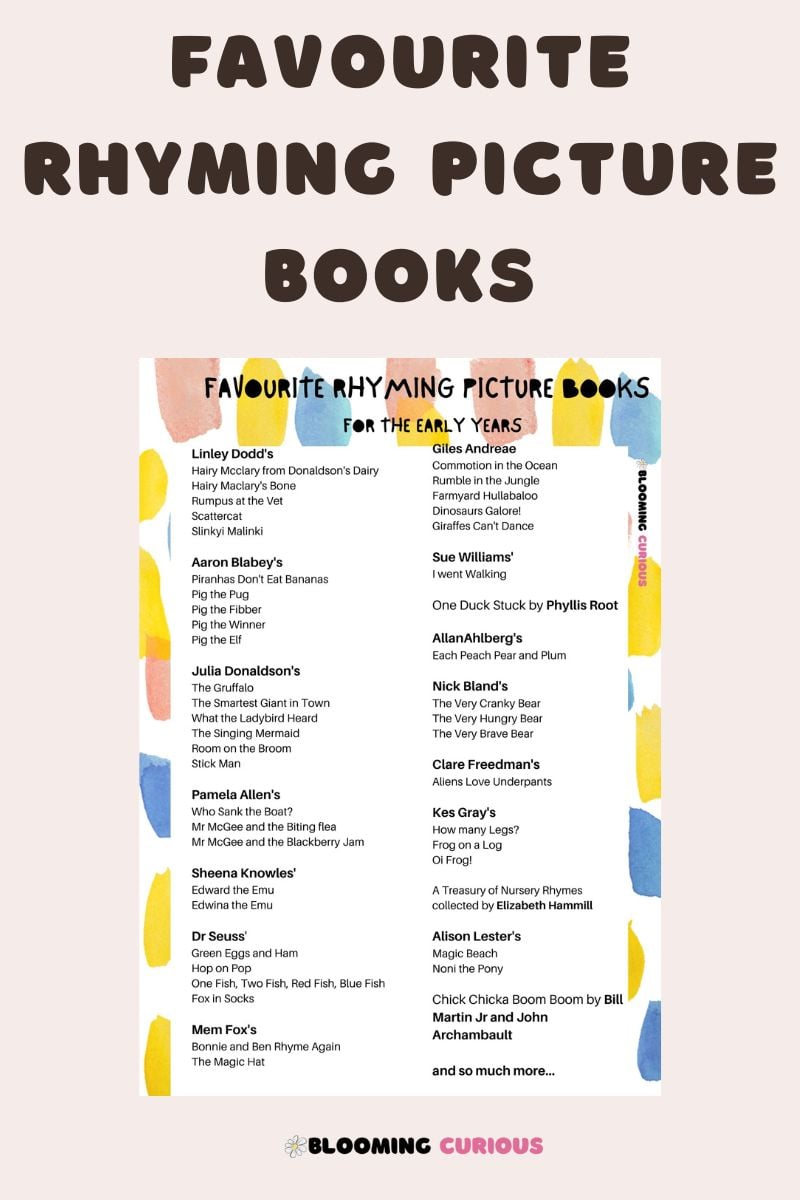
👉 Download this list for free here
Mathematical concepts are also non-negotiable. I personally love Dr Paul Swan’s resources where he tells you exactly how to plan and how to reach every mathematical milestone.
So English in all its nuances and mathematics are non negotiable.
Streamlining the Curriculum
As educators, we often grapple with the question of whether young children truly need exposure to the extensive curriculum areas. I challenge the necessity of the range of curriculum subjects that are required to be taught in early childhood.
I would prefer to see a focus on English, Math, Art, Music, and Stem, or more specifically, inquiry projects that encourage critical thinking, questioning and problem solving.
Please note this does not mean if a child is interested in Dinosaurs we are going to stop everything else and only let this child learn about dinosaurs. It means as educators who know the curriculum we use appropriate picture books and nature to drive the learning, and in that process children will have things they are interested in and then we allow them to pursue that. For example if you're studying the ocean and sea creatures, you teach about fish and ocean mammals, and in addition you allow children to learn more about a sea creature of their choice.
In order to streamline the curriculum our emphasis must be on integrating subjects through meaningful, inquiry-based learning, and literature, while still teaching core subjects like English and Mathematics and skills training.
The Magic of Inquiry-Based Learning
Inquiry-based learning is the secret sauce, transforming lessons into engaging and meaningful experiences. Instead of merely presenting facts, this approach nurtures curiosity, encouraging children to ask questions, explore, experiment, and discover.
For instance, during playtime, if kids are fascinated by insects, turn it into a mini-project! Build on their interest by reading books about bugs, creating an insect habitat, or even going on a bug hunt outside. It's about harnessing their natural curiosity and making learning an adventure.
Just by taking this interest in insects for example we can teach language concepts, mathematical concepts, ( e.g. if you have 3 beetles, how many legs would they have altogether? And right there you are now learning about groups of, which is actually repeated addition and multiplication so 3 groups of 6).
What about teaching children to ask really good questions that lead to discovery? This forms part of Inquiry Skills which is part of the Australian Science and HASS curriculum.
In year 2 for example, we teach report writing - check out my favourite book in the world Pie Corbett’s Talk for Writing Across the Curriculum which is a fantastic resource for teaching non-fiction writing.
We're linking our teaching of report writing to children's inquiry project about insects. And in addition, children can draw and paint or even make models of their favourite insect which ticks off the art and technology curriculum.
This simple example of students' fascination with insects turns into a multi-faceted inquiry project spanning language concepts, mathematical concepts, inquiry skills, writing, and art. This graphic organiser is perfect for those moments when you need a handy resource to scaffold children's inquiry into the critters they find.
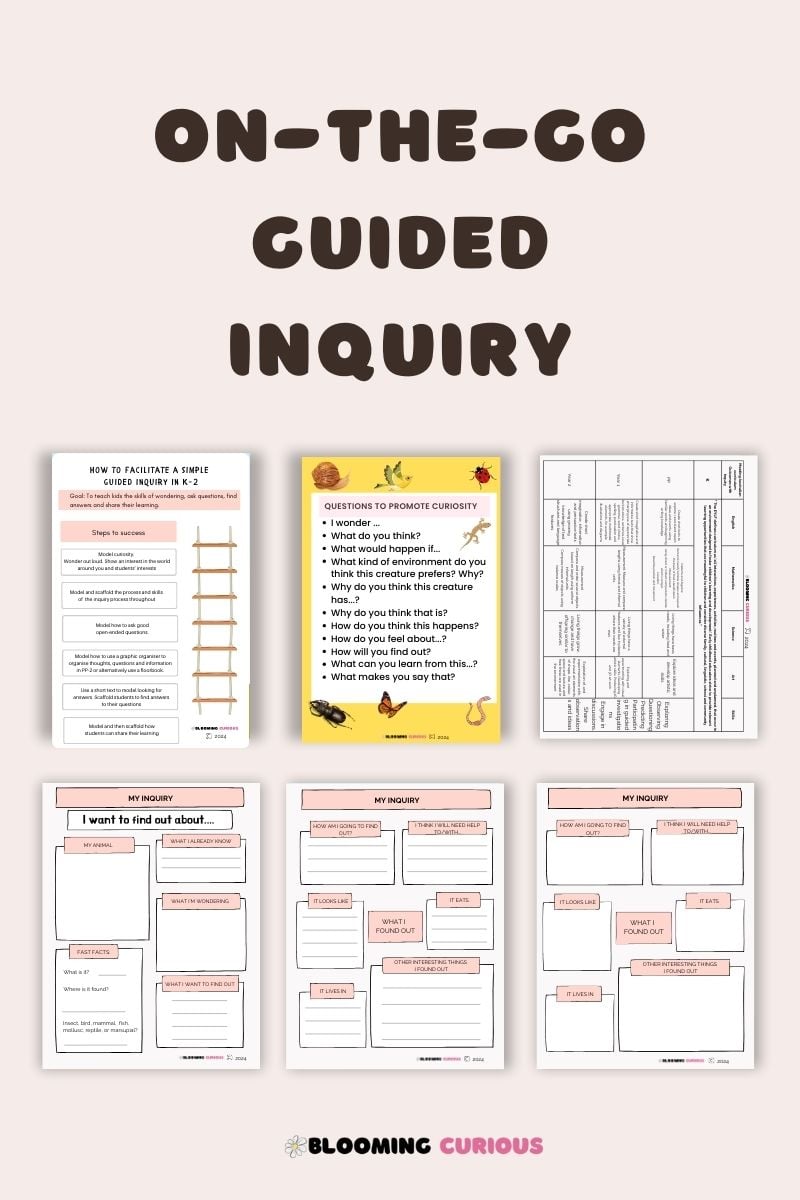
👉 Download this graphic organiser here
Practical integration of Inquiry into schedules
The big question is: How do we integrate inquiry-based learning into our daily schedule?
We dedicate blocks of time where children can delve into their interests. It could be a part of your morning circle or an afternoon session allowing for open-ended exploration. This approach not only fosters a love for learning but also allows you to intertwine various subjects seamlessly.
I have always found that English and Math – the heavy lifters are best in the morning when kids are fresh and alert, and then the afternoons can be used for inquiry and investigation which will cover everything from art, technology Science and Humanities.
New concepts and inquiry skills and process all still need to be taught explicitly through modelling and scaffolding.
Picture books are also provocations that do a lot of heavy lifting. If you choose the right book, it can cover multiple areas of the curriculum AND align to Science or Humanities OR both!
The lesson plans below all meet multiple curriculum outcomes, have an inquiry component, and hands-on learning experiences along with curriculum links and cater for learners from K to 2.
Save your planning time and your sanity while engaging children in meaningful, engaging learning experiences.
👉 Get your integrated lesson plans here
A timetable is a tool, not a rule
In conclusion, a timetable is a tool, not a strict rulebook. Be open to changes and adapt based on the needs and interests of your learners. And, most importantly, remain flexible!
Tune in to Blooming Curious every Tuesday wherever you listen to podcasts for more tips and discussions about how to best serve children's educational needs and keep them curious.
If you found this information helpful, please share it with someone else who can benefit. Together, let's spread the word and ensure that more children benefit.
Does any of this resonate with you? Then click one of those sharing buttons below and share it with someone you think will also appreciate it.
Sign up to Get Curious for weekly inspiration.
Comments ()